

The playbook investors relied on is slowly breaking down, and changes are being made. For decades, investing in gold futures has been a reliable hedge during times of rampant inflation, geopolitical stress, and equity market uncertainty. As risk rose, gold typically followed, adequately diversifying a proper portfolio.
But that relationship is starting to change in ways that matter for every investor, big or small.
In recent months, gold futures have been showing positive correlation with equities, moving up and down alongside stocks rather than against them. Its traditional role as a portfolio stabilizer is shifting, and gold is no longer acting purely as a “risk-off” asset the way it once did. In fact, gold’s volatility has now breached the top 5th percentile of all readings going back to 1971 — a degree of volatility rarely seen in an asset that investors consider a stabilizing force.
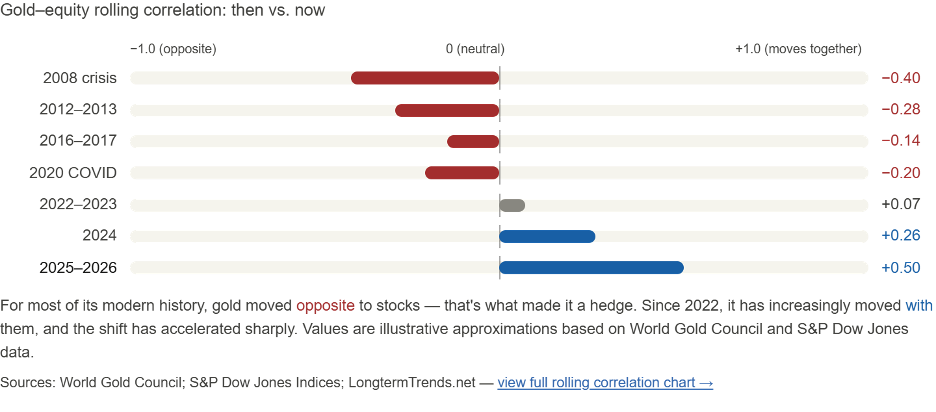
These dynamics show that gold is no longer a purely macro-driven trade. Its short-term moves are increasingly dominated by ETF flows and retail positioning. The scale of that activity has become staggering. In just one week in January 2026, gold ETF trading surged 137% week-over-week, contributing to a single-day trading volume of $965 billion, the highest level ever recorded. Central bank activity layered on top has amplified this further, making gold futures sensitive to cash flows and sentiment in a way that’s historically new.
When the gold price spiked from $5,000 to $5,500 in just three days earlier this year, it wasn’t driven by a geopolitical event or an inflation print, but by speculative positioning,
high-volume trading, and ETF momentum. That’s a fundamentally different beast than the gold investors grew up with.
For investors, this removes a key pillar of diversification. The traditional methods of hedging the market are being eroded by the entrance of a new era. When both assets decline simultaneously, investors are doubly exposed with nowhere to hide within their public market portfolio.
This marks a broader weakening of the traditional relationships between asset classes. When stocks, bonds, and gold all move together, diversification loses its meaning. The portfolio math that investors have relied on for a generation no longer holds cleanly.
In this environment, traditional public market hedges are falling short. With markets driven increasingly by sentiment and liquidity flows rather than underlying value, alternative investments can offer more stability for investors seeking genuine diversification. Private market assets, being underwritten on cash flows and operational fundamentals, aren’t subject to the same daily sentiment swings that are distorting gold futures and equities alike.
At Eppler Capital Funds, we focus on seizing these opportunities in the private markets. Building investment strategy on underwriting, cash flows, and operational value, we deliver consistent, risk-adjusted returns. In a world where the old playbook is being rewritten, the edge belongs to those who look beyond the public markets.